On SundanceTV, Wednesday at 10 p.m.
Showing posts with label Aspergers in the Community. Show all posts
Showing posts with label Aspergers in the Community. Show all posts
Monday, July 11, 2016
British autism show to air in US
https://www.bostonglobe.com/arts/2016/07/10/the-word-adept-exploration-autism/wTt3CfRI5yJEGZGHF916AM/story.html
On SundanceTV, Wednesday at 10 p.m.
On SundanceTV, Wednesday at 10 p.m.


Tuesday, June 28, 2016
Student creates comic about aspergers
http://federalstudyresearch.com/student-creates-comic-series-to-explain-her-life-with-aspergers/


Student Creates Comic Series to Explain Her Life With Asperger’s
UNCATEGORIZED June 28, 2016 No Comments on Student Creates Comic Series to Explain Her Life With Asperger’s 375
Siara Hughes studies graphic design and visual communications at Highline College in Des Moines, Washington, and for one of her final projects last quarter, she decided to produce a comic strip focused on her life with Asperger’s syndrome.
“I really wanted to tell a story that would help me explain myself, what autism means for me, what my struggles are, and how I’ve had to work through them,” she told The Mighty.
“This comic is the culmination of dozens of hours of work, lots of frustration, a couple of tears, and an earnest desire to explain myself to other people,” she added on her DeviantArt page.
Hughes, 21, told The Daily Dot she diagnosed herself with Asperger’s after identifying with an autistic character in a book and then doing research. When her younger brother was diagnosed with autism, she noticed a number of similarities between the two of them, and found an explanation for how she’d been feeling.
“Watching him go through the daily challenges of school while having them compounded by ASD reminded me of my own childhood struggles and became a sort of inspiration for the project,” she told The Mighty.
Editor’s note: These comics are based on one person’s experience.
Hughes is sensitive to light, heat and touch, and she finds eye contact difficult. Hughes said she’s known she was different for quite some time, but it wasn’t until she learned more about Asperger’s that she began to feel understood.
“If I’m going to understand someone else and befriend them and interact in a positive way, I need to get inside their psyche and understand what’s going on under there,” she told The Daily Dot. “I want to be able to communicate, I want to be able to understand people, and it means I have to learn how to do it.”
So far, Hughes has received a very positive response to the project. “When I turned in the story board, my teachers got really excited about it and asked me if I’d make a poster version for Student Services on campus,” she told The Mighty. “I then decided to adopt the eight-panel story board into a 12-panel webcomic that more completely told the story. I first posted the comic about two weeks ago on DeviantArt and it’s gotten more feedback than just about anything I’ve every posted.”
Hughes also opens up about meltdowns, and how stressful they can be for her.
“The meltdowns don’t happen on cue,” she told The Daily Dot. “I don’t will them to happen; I will them not to happen. I don’t like falling apart in public.”

“My goal in all of this is just to help people understand,” she told The Mighty. “To understand me, my little brother, and all the other high functioning autistic people out there like us. And maybe to help us better understand and explain ourselves.”
Monday, May 9, 2016
Arthur- Teaches about aspergers
Arthur- When Carl Met George (full episode).mov
I stumbled upon this. As I have stated a few times before every person with aspergers is different. You can see the signs he has of aspergers: not understanding social cues, being really interested in a certain thing, facts, sensory overload, and being smart.
A great thing that someone can do for a person with aspergers is what George does for Carl that he is a freind to him.
Sunday, May 1, 2016
Sunday, April 3, 2016
Israel defense force expanding autism program
IDF expanding Autism program


The IDF's “Roim Rachok” (“Watching the Horizon”) program, which integrates soldiers on the autism spectrum into the IDF, has expanded to the Ordnance Corps, reported the IDF Blog Saturday evening.
Roim Rachok volunteer IDF Website
The Ordnance Corps is now welcoming its first eight autism spectrum volunteers, as part of Roim Rachok. After testing and interviewing approximately 70 candidates, eight men were chosen to be a part of the program that began in November 2015.
“These men embody extraordinary visual memory and a great desire to learn and work in the best possible way,” the military blog quoted Major Yitzchak, Commander of the Optotronics Unit, as saying.
Autism-spectrum IDF volunteer. IDF Website
"It’s amazing to see the progress in these men,” he added. “They come on the day of their interview, shy, hardly understanding the wires and tools in front of them. Today, they are working just like their peers beside them.”
The volunteers learn social skills along with specialty skills. They attend recreational yoga classes, but also learn how to carry out routine activities like riding a bus. Four of them will be joining an optics unit and four will be in electronics.
Since tasks like fixing wires and molding cord coating are part of the work in almost any electrical field, the IDF hopes to make the volunteers as comfortable as possible in a normal workplace, both in and out of the army.
Autism-spectrum IDF volunteer. IDF Website
On June 30th, the future soldiers will wear their IDF uniforms for the first time. “I just want to be like everyone else,” Omer K, one of the future recruits in the group, told the blog. “I am very excited to put on the uniform.”
Maj. Yitzchak added, “The project creates a beneficial environment for both the volunteers and the IDF. The proteges receive occupations for life and we receive experienced, efficient, and motivated workers.”
Thursday, February 25, 2016
Israeli autism unit in army helps individuals develop
http://www.ynetnews.com/articles/0,7340,L-4768429,00.html
When I posted a simmilar article this was the point that stood out to me that disabled people are being helped to develop through this program. That will save so many people time and money helping these people out
Pvt. E never thought he'd join the army. As someone on the autism spectrum, he struggled with certain social situations and would get easily distracted. Now, at 19, he is serving in a sensitive intelligence unit in the Israeli military, working in software quality assurance and defying what he and many of those around him thought he could accomplish.
Israel has for decades exempted people on the spectrum from joining the military, a compulsory duty for most Israeli Jews. But in recent years it is increasingly enlisting them, harnessing their special capabilities for certain meticulous tasks and including them in an Israeli rite of passage that can boost their independence and open professional doors.
"It gives me a chance. It gives me education, on-the-job education," said Pvt. E, whose name could not be published and whose face could not be photographed because he serves in a classified intelligence unit. "It's a beginning. It's a very solid beginning."

The IDF has developed into a more inclusive military. (Archive photo: IDF Spokesperson)
Pvt. E. is part of a program called Roim Rachok, or "seeing into the distance," which provides training and assistance to Israelis on the autism spectrum who wish to enlist in the military. The program's founders saw the inclusion of people on the spectrum as a way to help usher them into a self-sufficient life once they are discharged.
Until recently, people on the spectrum were largely sidelined from the military, allowed to volunteer but without a proper framework to ease them into the challenges of military life. Roim Rachok, and at least one other program that has sprouted up, is doing just that.
The Israeli military serves as a great equalizer where youth from all walks intersect and those who do not enlist can find themselves at a handicap once they hit the job market. One's military career can often be a key determinant for employers and soldiers who served in intelligence units often land coveted jobs in Israel's booming tech sector.
People on the spectrum are dealt another challenge once they reach 21, the age when state-funded programs and assistance are mostly cut off, leaving them to fend for themselves or depend on their parents for support. Roim Rachok hopes to provide its graduates with a softer landing through inclusion in the military.
"Many sit at their parents' home and don't do anything. That is the painful reality," said Tal Vardi, a retired security official who is co-founder of the program. "This program gives every adult on the spectrum the opportunity to realize his full potential. And the moment we give them opportunity it puts them and us as a society in a different place."
Dozens of people on the spectrum have participated in the program since 2013. They undergo a three-month training session at the Ono Academic College outside Tel Aviv that tests their skills and determines whether they could handle the military's rigid nature. They then serve in a civilian capacity in a military unit for another three months before they officially enlist.
The program seizes on the participants' perceptive capabilities and their knack for precision or repetition and places them in the military's most elite and sensitive intelligence units, where they pour over satellite imagery or, like Pvt. E., serve in quality assurance roles, verifying that the software the military develops is flawless. The program is expanding to address people with skills other than heightened perception, training soldiers for roles in combat support as well.

Some autistic soldiers serve in highly sensitive IDF intelligence units. (Archive photo: IDF Spokesperson)
Once in the army, the soldiers are accompanied by an occupational therapist and a psychologist, lending support both to the people on the spectrum and their commanders and colleagues who may need guidance in their relationship with the soldiers.
Unlike typical recruits, who serve close to three years, these soldiers have a basic, voluntary, service of one year. But they are allowed to extend their service and volunteer for an additional two years if they choose. Roim Rachok also provides guidance once they leave the military.
Autism is a developmental disorder that can involve language and social impairments, affecting people to varying degrees. Many of the participants in Roim Rachom are considered "high functioning," meaning they have above-average intelligence but may have difficulties with social interaction and communication.
Not all soldiers on the spectrum qualify for the program and of those who do, not all have gone on to serve in the military, Vardi said. He said that much of the soldiers' success depends on how tolerant and accepting the people they work with can be, which is why support staff are deployed to help.
"Often the operational difficulty brings with it some sort of emotional difficulty," said Capt. Y., who commands six soldiers who are on the spectrum. "There may be a soldier who really struggles with the work and he isn't succeeding and you need to know how to deal with it."
In the small office in downtown Tel Aviv where Pvt. E. and his fellow soldiers are based, they toil away on computers beneath pulled blinds, shielding their classified work from prying eyes outside. A corkboard spelling out the day's to-do list hangs on the wall beside a whiteboard, where the soldiers draw up mathematical equations during their spare time.
"It's revolutionary," said Pvt. Y., a soldier who also works in quality assurance, of his military service. "It proves that even though others say we cannot, we can."
When I posted a simmilar article this was the point that stood out to me that disabled people are being helped to develop through this program. That will save so many people time and money helping these people out
Pvt. E never thought he'd join the army. As someone on the autism spectrum, he struggled with certain social situations and would get easily distracted. Now, at 19, he is serving in a sensitive intelligence unit in the Israeli military, working in software quality assurance and defying what he and many of those around him thought he could accomplish.
The IDF has developed into a more inclusive military. (Archive photo: IDF Spokesperson)
Some autistic soldiers serve in highly sensitive IDF intelligence units. (Archive photo: IDF Spokesperson)
Monday, February 15, 2016
Sunday, January 31, 2016
A disability based organization changing the campaign trail
Dahlia Joseph and James Trout have a rhythm. Trout either positions himself in the front row or figures out which campaign staffer has a microphone for the audience Q&A. Either way, he aims to maximize his chances of asking a presidential candidate a question. Joseph takes her position in the press pool, with her Canon EOS Rebel T5 camera. After weeks in Iowa and New Hampshire, where they’ve attended dozens upon dozens of campaign events, they’re now pros. Trout usually tells candidates that 70 percent of people with disabilities are unemployed, and then asks them what they intend to do about it. Dahlia captures it on film.
Joseph told me, “James and I—we’re a team. We’ve worked together for so long now that we have a flow when we go to events. It’s unspoken. We don’t even talk about it. We know exactly what we’re supposed to do.” Sure, events don’t always go as planned. Sometimes the twists and turns of a campaign event pull the candidate’s attention away from them, but there’s always the next town hall or rally. They’re in this for the long haul.
2015 marked the 25th anniversary of the Americans with Disabilities Act (ADA). The ADA has made life better for disabled Americans in many ways, but also failed in a few important respects. Unemployment remains shockingly high as do rates of violence against disabled individuals. The disabled community has never acquired the level of political influence its numbers would seem to justify. RespectAbility, a nonpartisan nonprofit focused on shaping policies that affect disabled Americans, aims to change that. It’s put a class of fellows on the campaign trail, Trout and Joseph among them, to attend presidential campaign events over the last few months.
Ben Spangenberg and Justin Chappell spent two weeks in January traveling around Iowa, committed to a grueling schedule to get to as many campaign events as possible. Chappell, who married Spangenberg last November, called it “a political nerd’s dream honeymoon.” Both men are wheelchair users with spina bifida, and the snowy sidewalks, ramps, and streets of Iowa were not always easy to navigate. At one Ted Cruz rally where the pair couldn’t get close during the event, Chappell made his way towards the stage while Spangenberg circled around the building to wait by the bus, hoping to catch the senator on his way out. “It was really cold,” said Chappell, “and Ben was outside for at least half an hour waiting for the senator to come outside to talk to him. We didn’t take the easiest path to talk to these candidates.”
One issue, says Jennifer Laszlo Mizrahi, the CEO of RespectAbility, is the conventional wisdom that all people with disabilities are Democrats fixated on government spending. She told me, “Democrats take the group for granted, and Republicans don’t reach out to it,” even though her data says that disabled Americans are much more interested in opportunity than government benefits. That’s an approach that could easily bridge both sides of the aisle.
The complexities of disability culture, though, also come into play. Many disabled individuals reject the word disability, claiming only their specific diagnosis or dismissing language of impairment all together. Stigma forces many people with invisible disabilities to pass as typical if they can. Voting sites are not always fully accessible, depressing the percentages of disabled voters in any region. Disability-rights organizations tend to be focused on promoting and shaping specific policies, brilliant in their wonky advocacy, but perhaps less focused on broad political impact. Finally, it’s possible that the fact that disabled Americans come from all political parties, races, classes, religions, and regions makes it difficult to build political coalitions around electing specific candidates. And yet, disabled people have specific needs that the political process seems to be ignoring.
As the presidential election cycle got underway in 2015, Mizrahi launched a new approach to make every candidate think about the issues most important to disabled Americans. Instead of forming a super-PAC or trying to influence specific candidates through donations, she found funding to hire a group of fellows and send them out into the field. Many of them are disabled. All of them are keenly aware of the major issues facing the community. They would act as journalists, writing reports under the editorial oversight from Communications Director Lauren Appelbaum. When possible, RespectAbility would obtain press credentials for fellows, getting them access to post-debate “spin rooms” and press conferences. Otherwise, the fellows would do what reporters have always done—log the miles, ask the questions, and report on the answers.
More significantly, the campaigns are getting better at answering the questions.Jeb Bush took a question from Trout at Grinnell College a few weeks ago. First Bush talked passionately about employment, and then a few minutes later cycled back to Trout’s question to call Donald Trump a “jerk” for disparaging people with disabilities. Chappell described meeting Bill Clinton in Iowa and asking about his wife’s support for SSDI. A few days later, at another event, the former president paused to call out Spangenberg and Chappell in the front row, compliment them on their hard work, then took five minutes out of his stump speech to tout his administration’s work on supporting SSDI, before transitioning to his wife’s plans to go even farther if she’s elected.
Candidates don’t want to get caught on film unprepared on these issues. When they see the reporters from RespectAbility coming, they prepare clear talking points.
The success of this handful of reporters on the campaign trail highlights how inadequately conventional media outlets have highlighted these issues in the past. Few reporters are savvy about disability, beyond the basics of reporting on inspiring achievements or horrific tragedy. Major news outlets almost never have anyone on a disability “beat,” but rather fold such issues into health and medicine. Many in the disability community have spent 40 years trying to move outside a medical model of disability, but the media has been slow to catch up.
The RespectAbility fellows are not traditional, objective, political reporters. They are avowedly nonpartisan, but they are in Iowa and New Hampshire to shape the news, not just cover it. To some extent, though, that’s true of all reporters. Anyone who chooses to ask a candidate about one issue rather than another influences the realm of possible answers and the parameters of political debate. Groups and individuals who would like more discussion of their issues—climate change, reproductive rights, eminent domain, the drone war—complain about this routinely. Instead of complaining, though, the RespectAbility fellows are succeeding in shifting the conversation, just by showing up on the trail and asking questions. In the age of super PACs and the most expensive presidential campaign in U.S. history, that’s a remarkable accomplishment.
Monday, July 20, 2015
Monday, July 6, 2015
A Teen With Asperger’s Taught The Bullies Who Attacked Him A Lesson Instead Of Pressing Charges
original article
Stephanie McNeal
Gavin Stone was diagnosed with Asperger’s syndrome and ADHD when he was a toddler. Since then, his mom, Cortnie, said the family has faced both challenging and joyful times.

Cortnie Stone / Via Facebook: cortnie.stone
Gavin is pictured center.
The Illinois teenager has difficulty maintaining relationships and tends to isolate himself, Cortniewrote on Facebook.
“He can appear rude, impatient, ‘weird,’ detached, or uninterested, but this is not intentional,” she wrote. “He can also be kind, generous, and forgiving, but even this can appear awkward at times because some of it is learned and not always natural.”
Gavin worked hard to learn social cues, but still has challenges. “Being a teenager with Asperger’s is tough because all [of a] sudden people around you are consistently ‘breaking’ all the social do’s and don’ts you’ve spent years learning,” his mom said.

Cortnie Stone / Via Facebook: cortnie.stone
Last week, something horrible happened to Gavin: He was beaten up by kids he didn’t know. Stone explained on Facebook:


But rather than press charges against the bullies, Gavin is hoping to raise awareness about his condition.
Stone wrote that he requested for their community service to be disability-related, that they write a paper on Asperger’s, and that they should watch a 20-minute video statement “he taped while their families were present so they could see the damage they did and hear the event from his perspective.”
Gavin’s story is spreading through the internet after it was shared by Susan Moffatt, the mother of a friend of Gavin’s. Moffatt’s post has been shared over 140,000 times.

Susan Moffat / Via Facebook: smoffatt2
Gavin Stone and his friend, Jonathan Moffatt.
Moffatt wrote her son is also disabled, and it broke her heart to see what has happened to Gavin.
Now Stone says she hopes that something good with come of what happened to her son:
BuzzFeed News has contacted Stone and Moffatt for comment.Stephanie McNeal
Monday, April 13, 2015
Monday, January 26, 2015
How an aspergers person should go about getting a job
I remember so many interviews I went to and failed. A lot of them I did things that hurt me in my interview (or was naive in how I went about what they were saying).
For many people with aspergers, and many people in general it's a good idea to rely on your experiences, and skills to get you a job. First of all if you are competeing for a low level job you will have a lot of competition. If you find something you can start doing small things for and building experience then you can use that to seperate you from everyone else. Making these things the focus of why you should get a job instead of your social skills is a great idea for a person with aspergers.
I was thinking about myself that approaching a job this way is a lot better for me (in that I myself could get a job better).
Wednesday, January 21, 2015
Tackling transport troubles for the disabled | ISRAEL21c
Tackling transport troubles for the disabled | ISRAEL21c


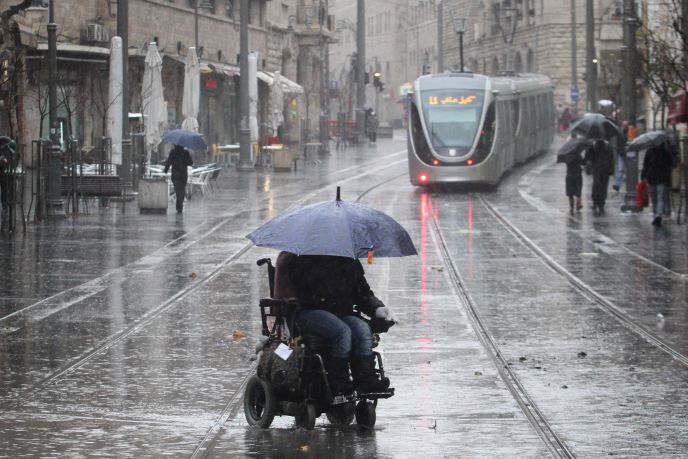
Navigating public transport can be difficult for people with disabilities. Photo by Miriam Alster/FLASH90
As of December 31, 2014, there is a new law on the books in Israel mandating that all public transportation must be wheelchair-accessible. Still, this does not completely solve the issue of mobility difficulties on buses, trains and taxis for people with disabilities.
“Galgalim Darom” (“Wheels in the South”), an innovative program tailor-made for Israel, was recently launched for people whose physical or mental challenges hinder their ability to get around independently.
Galgalim’s mission is to provide various forms of transportation assistance to individuals with different kinds of special needs, so that they can be as active participants in society as everyone else.
The program will help the 67,000 residents of southern Israel with a disability – and eventually all of Israel’s approximately 697,000 disabled adults between the ages of 21 and 65 — to get to work or shop at a mall without the added pressure of calculating how they are going to manage the trip itself.
The project is backed by the Ruderman Foundation and is the brainchild of the Joint Distribution Committee’s Department of Disabilities and Rehabilitation, with cooperation from Israeli institutions such as the Finance Ministry, the Ministry of Welfare and the National Insurance Institute.
According to Tal Goldman, project manager for the Tel Aviv-based non-profit organization Transport Today and Tomorrow, which is a partner in the program: “This will open up new vistas for people who otherwise would be limited in their ability to find employment, to visit friends and family and to have the ability to enjoy their leisure time.
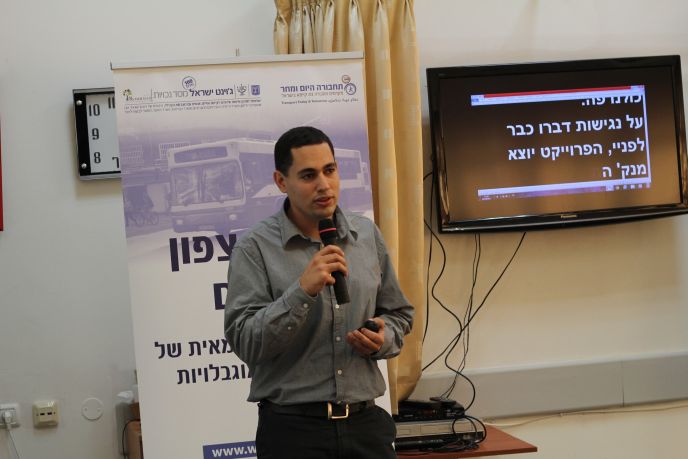
Tal Goldman of Today and Tomorrow.
Goldman told ISRAEL21c that the program will include an information hotline to provide assistance in planning rides on public transportation and everything connected with travel, such as advance purchase of tickets and eligibility for discounts. This line will also serve as the address for receiving “first aid” advice and for filing complaints.
The bulk of the program, however, will revolve around an extensive network of volunteers teaching the target population how to use public transportation, often accompanying disabled travelers to their destinations.
“Our aim is for as many people as possible to be able to utilize our infrastructure,” said Goldman, explaining that volunteers will be recruited from among the community with disabilities as well.
For example, he said: “Someone in a wheelchair who has a car might become a driver for someone who is visually or cognitively impaired.”
Alone with his guide dog
Galgalim Darom was launched on December 2 at a conference in Ashdod, in the presence of Knesset members, Transportation Ministry officials, and representatives from the Egged bus company, the Ashdod municipality, the Department of Disabilities and Rehabilitation in JDC-Israel and Transport Today and Tomorrow.
Arkady Balanovsky, a veteran immigrant from the former Soviet Union, was also in attendance. The 59-year-old Ashdod resident, who went blind a few years ago after being diagnosed with artemis pigmentosa, took to the podium to describe the benefits of Galgalim Darom for people like him.
Balanovksy subsequently told ISRAEL21c his tragic personal story – one paved with loss. In the space of five years, he lost his eyesight and thus his job as a construction engineer; he lost his wife to cancer and his 34-year-old son to liver failure; and he lost both his parents and in-laws.
“I am all alone now with my seeing-eye dog,” he said, matter-of-factly. “And though life must go on, it is very difficult for me to get from place to place without the help of other human beings.”
Balanovsky continued: “It is the lack of understanding of what people with disabilities go through just to get on a bus or take a train that makes a program like Galgalim Darom so necessary.”
Though the program is still in an early stage, Goldman is very optimistic about its future.
“The response on the part of the local authorities and so many other groups has been incredibly positive,” he says, adding that he and his partners are in the process of recruiting volunteers. “And the more we get, the more extensive the program can become.”
The next step is to advertise the various services that will be available to people with disabilities, and to encourage those people to take advantage of them.
Goldman’s forecast is grandiose: “Within three years, we aim to have the program running so effectively that the Israeli government will take it over and expand upon it,” he said.
For more information, click here.
Thursday, January 15, 2015
Yonatan and Aaron Raz'el: Ibdu
The words are Ivdu et Hashem bsimcha from Psalm 100 which everything he sings is:
Serve G-d with gladness, come before him with joyous song. Know that G-d (the attribute of kindness), is G-d (the one who gives us our diffuculties). It is him who made us and we are his
Thank you Rabbi Lazer Brody for bringing this to my attention
Yonatan and Aaron Raz'el: Ibdu
Tuesday, December 23, 2014
The importance of developing skills
One thing that can really improve an asperger person's life is teaching them skills. This includes hygine, cooking (a very expansive area), and so many other things. When someone sees that they can do something they feel better about themselves. They will believe in themselves and be able to acheive so much more.
This can help a person with Aspergers get a job. Who is more likely to get a job a person with a disability or a someone without? The answer is simple the person without a disability. But what if the person with a disability knows something like selling on ebay, ironing clothes, or with other skills, and the person without a disability doesn't know anything about that area. It changes the situation.
This can help a person with Aspergers get a job. Who is more likely to get a job a person with a disability or a someone without? The answer is simple the person without a disability. But what if the person with a disability knows something like selling on ebay, ironing clothes, or with other skills, and the person without a disability doesn't know anything about that area. It changes the situation.
Subscribe to:
Posts (Atom)